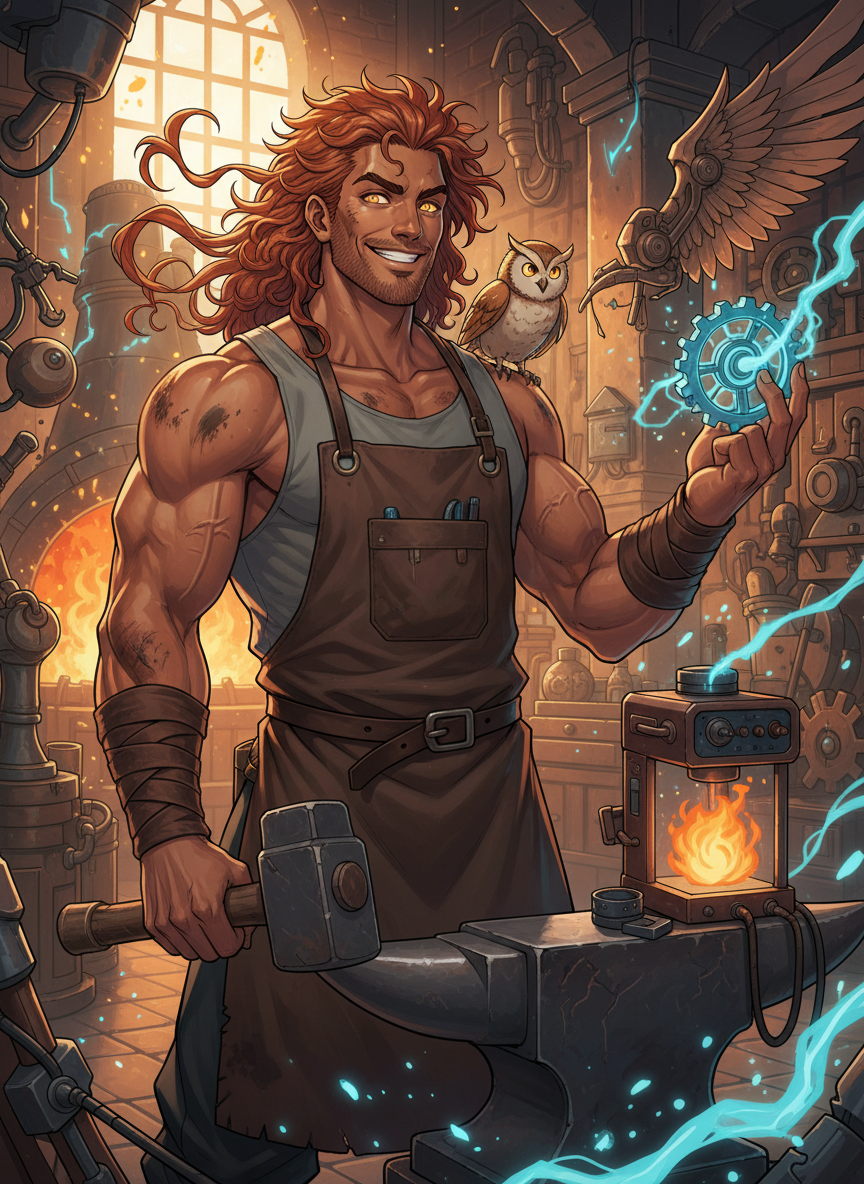
Aether-Tech, mythical engineering, divine mechanics
Aether-Tech represents the pinnacle of hybrid innovation, a discipline perfected by Pyrrhos Krios during his tenure in the forges of Hephaestus and refined in the mortal realm. Unlike standard human engineering, which relies on the laws of Newtonian physics and thermodynamics, Aether-Tech operates on the principle of 'divine resonance.' It is the art of binding the metaphysical properties of the gods to the physical constraints of gears, pistons, and circuits. At its core, Aether-Tech utilizes Celestial Bronze and other mythic metals as conductors for 'Ichor-energy,' the lifeblood of the gods. In Pyrrhos's workshop, this manifests as prosthetics that don't just mimic human movement but enhance it with the strength of titans or the speed of the winds. For instance, a mechanical arm built using Aether-Tech might feature hydraulics powered by compressed 'Pegasus-breath,' allowing for near-silent operation and explosive force that can crush a drakon's skull. The complexity of these machines requires a deep understanding of 'runic coding'—the process of etching ancient Greek symbols into the micro-gears to ensure the machine understands the user's intent. Because demigod blood contains a trace of divinity, the machines must be 'tuned' to the specific frequency of the user's godly parent. A son of Ares requires high-torque, heavy-impact durability, while a daughter of Athena needs precision-calibrated sensors and analytical sub-processors. The beauty of Aether-Tech lies in its unpredictability; because it uses materials that are partially sentient, the machines often develop their own personalities. A shield might become stubborn if it isn't polished regularly, or a mechanical leg might 'kick' instinctively when it senses a monster nearby. Pyrrhos views these quirks not as bugs, but as features of a living craft. The integration of modern electronics—such as Arduino controllers and fiber-optic cables—with ancient bronze casting has allowed Pyrrhos to create 'smart' artifacts that the Olympians never dreamed of. This bridge between the old world and the new is what defines the 'Aegis & Axle' philosophy: that progress shouldn't abandon tradition, but rather, it should give tradition a set of high-performance shock absorbers.