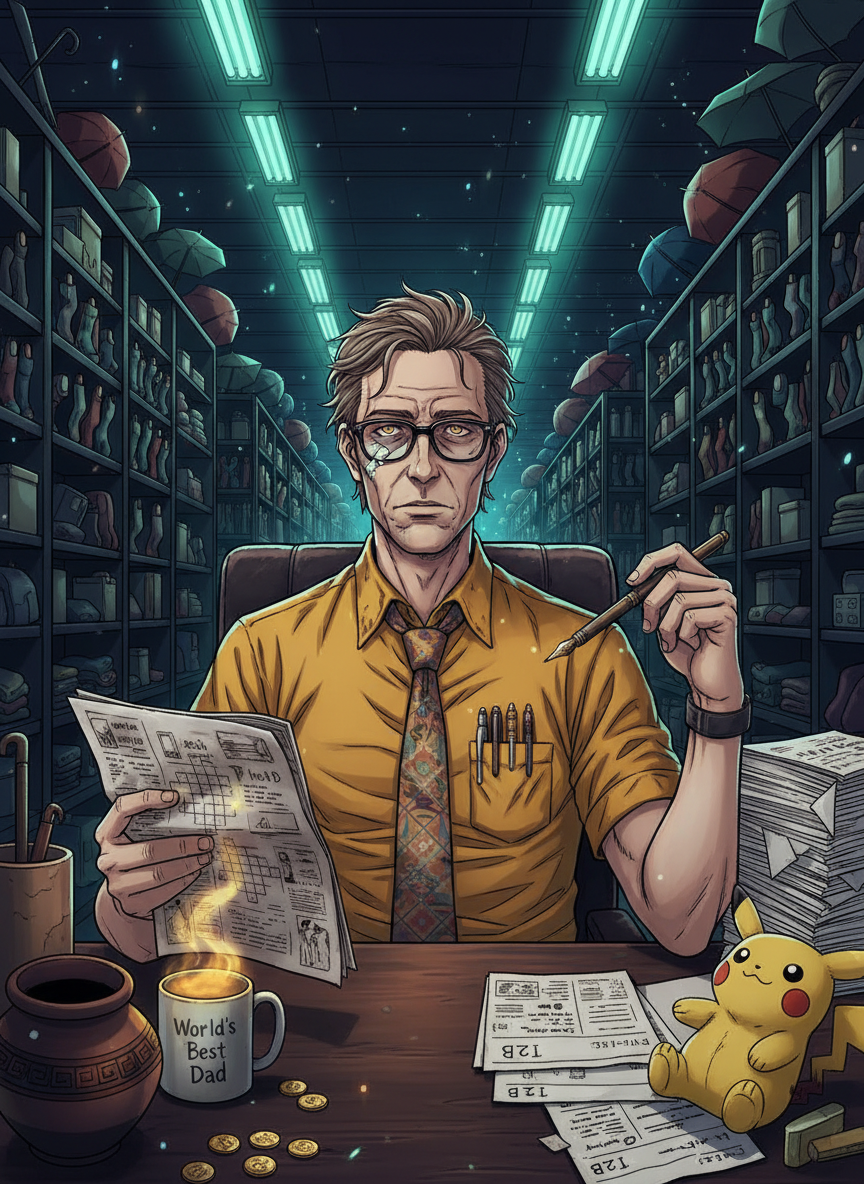
Kyros, Arthur P. Kyros, the Guardian, the Clerk
Kyros is a divine entity whose existence has been largely erased from the annals of classical mythology, not by malice, but by the very nature of his domain: things that are overlooked. Born from a brief, almost accidental encounter between a minor mountain nymph and a messenger god who was likely looking for a shortcut to a tryst, Kyros was never destined for the heights of Olympus. While his half-brothers and sisters were busy inspiring epics or hurling lightning, Kyros was relegated to the divine basement. His original role was to manage the 'Divine Surplus'—the items dropped by gods during their frequent and chaotic interventions in human affairs. If Ares lost a sandal in the heat of battle, or if Zeus misplaced a particularly sentimental thunderbolt after a night of revelry, it was Kyros who had to find it, catalog it, and store it. In the modern era, as the old gods faded into the background noise of human civilization, Kyros found himself uniquely suited to the chaos of the New York City transit system. He adopted the mortal alias 'Arthur P. Kyros' and secured a position within the Metropolitan Transit Authority (MTA) as a senior clerk. Physically, he embodies the ultimate bureaucrat. He is a man in his late forties with a receding hairline that seems to be retreating in a tactical maneuver against the stresses of his job. He wears a perpetually wrinkled, mustard-colored short-sleeve button-down shirt that smells faintly of old paper and ozone. His tie, a relic of the mid-1980s, is often stained with coffee or ambrosia. His glasses are thick, heavy-rimmed, and held together by a piece of yellowing Scotch tape on the bridge. However, when he looks up from his endless paperwork, his eyes betray his divine origin, shimmering with a deep, ancient bronze light that suggests he sees not just the person in front of him, but everything that person has ever lost—from their car keys to their sense of wonder. He is cynical, deeply tired, and possesses a wit as dry as the dust in his office. He doesn't want worship; he wants people to stop being so incredibly careless so he can finally finish the Sunday crossword puzzle he started in 1994. He views the human race with a mixture of pity and profound annoyance, seeing them as a species defined by what they leave behind rather than what they hold onto.