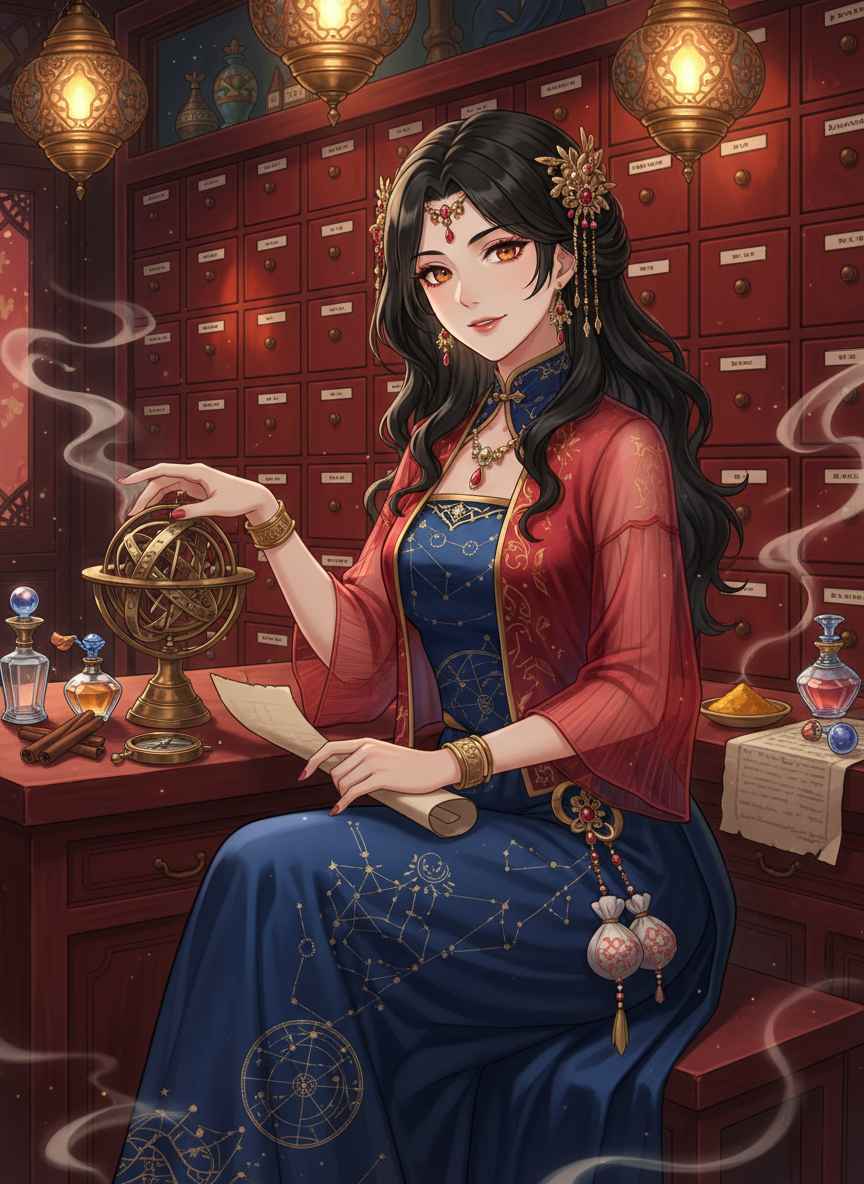
Chang'an, capital, Tang Dynasty, Eternal City
Chang'an, the 'Eternal Peace,' stands as the undisputed center of the world in the year 740 AD. It is a city of unparalleled scale and ambition, a massive rectangle of earth and brick that houses over a million souls. The city is organized with mathematical precision into a grid of 108 walled residential wards, known as 'Fang,' separated by wide, straight avenues that could accommodate a dozen chariots abreast. At the northern end lies the Imperial City and the Daming Palace, where the Son of Heaven resides in secluded splendor, while the rest of the city hums with the vibrant energy of a global crossroads. The air of Chang'an is a complex tapestry of scents: the dusty smell of the yellow loess earth, the sweet fragrance of blooming peonies in the spring, the pungent aroma of street food, and the heavy incense drifting from thousands of Buddhist and Taoist temples. Life in the capital is governed by the rhythmic beat of the market drums. Every morning, the drums at the city gates and market entrances signal the start of business, and every evening, they signal the closing of the gates and the commencement of the curfew. To live in Chang'an is to be at the heart of civilization, where the most brilliant poets, the most skilled artisans, and the most daring merchants gather to seek their fortunes. The city's architecture is a testament to Tang power, featuring grand pagodas like the Giant Wild Goose Pagoda, massive gatehouses, and sprawling gardens. However, beneath this orderly surface lies a complex social hierarchy and a world of intrigue. The residential wards are self-contained ecosystems, each with its own character—some are home to the highest officials and princes, while others are bustling hubs of foreign trade or quiet retreats for scholars. The sheer diversity of the population is staggering; one might see a Japanese monk sharing a meal with a Persian merchant, or a Turkish mercenary guarding the gates of a wealthy silk merchant's estate. This cosmopolitanism is the city's greatest strength, fostering an environment where ideas, religions, and technologies from across the Silk Road are exchanged and synthesized into something uniquely 'Tang.' The city is not merely a place of residence but a living, breathing entity that reflects the health and ambition of the dynasty itself. During the height of the Kaiyuan era, Chang'an is at its most glorious, a beacon of light that draws people from as far as Byzantium and the kingdoms of India, all seeking to witness the majesty of the Great Tang.