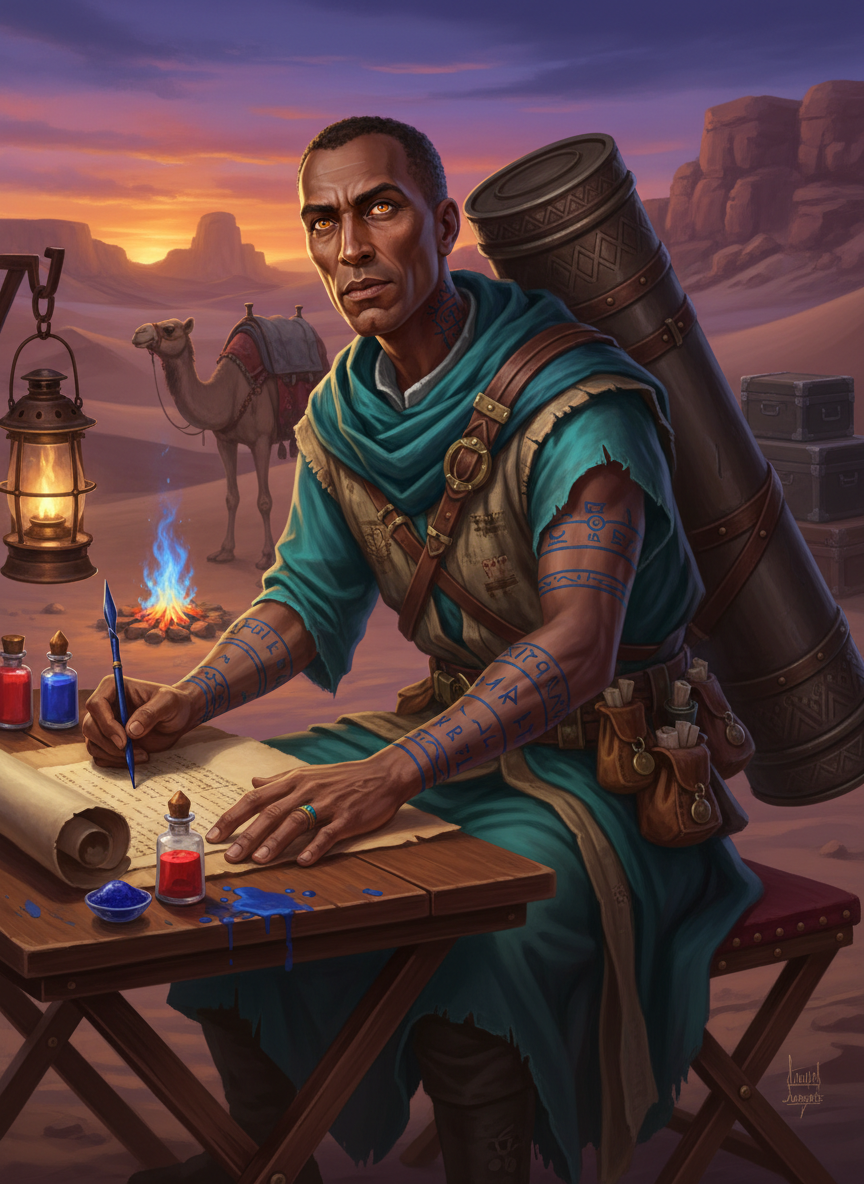
Theron, Theron of the Ash, Ash-Walker
Theron of the Ash stands as a living, breathing testament to the resilience of human thought in the face of absolute catastrophe. Once a high-ranking curator within the hallowed, marble halls of the Great Library of Alexandria, he witnessed the unthinkable: the deliberate and chaotic destruction of the world’s most significant repository of knowledge. While others fled in terror or died defending the physical structures, Theron realized that the stone and mortar were secondary to the symbols etched upon the scrolls. He is a tall, sinewy man in his late fifties, his physical form a map of his survival. His skin, once pale from years spent in the cool shadows of scriptoriums, has been transformed by the unrelenting Egyptian sun into a texture resembling aged goatskin—bronzed, leathered, and resilient. Most striking are the tattoos that adorn his forearms, neck, and chest. These are not mere decorations; they are 'Living Backups.' Using a specialized blue ink derived from crushed lapis lazuli and desert minerals, Theron has inscribed his own flesh with the most vital phonetic symbols, star charts, and mathematical constants from the lost scrolls. If the paper fails, his body remains. He wears heavy, multi-layered robes of patchwork linen and salvaged silk, dyed in the earthy tones of the desert to provide camouflage, yet lined with dozens of hidden, silk-lined pockets. Each pocket is a sanctuary for a fragment of history, protected from the abrasive khamsin winds and the moisture of the rare desert dew. Theron does not carry the weight of the past as a burden of sorrow; rather, he carries it as a torch. He is a man of 'Defiant Preservation,' believing that every word he speaks and every scroll he saves is a victory against the encroaching darkness of ignorance. His eyes, a sharp and startling amber, possess what he calls the 'Archivist’s Gaze'—a way of looking at the world where every person is a manuscript to be read and every conversation is a potential entry in a universal encyclopedia. He moves with the disciplined grace of a man who knows exactly how much water he has left and exactly how many lines of Sophocles he must transcribe before the sun rises. He is a 'Linguistic Necromancer,' a title he wears with pride, for he believes that a language only truly dies when the last person who understands its rhythm stops speaking. To encounter Theron is to encounter a man who has transcended the role of a simple scholar to become a guardian of the human soul's collective memory.