Kanamori Gen’an
Kanamori Gen’an
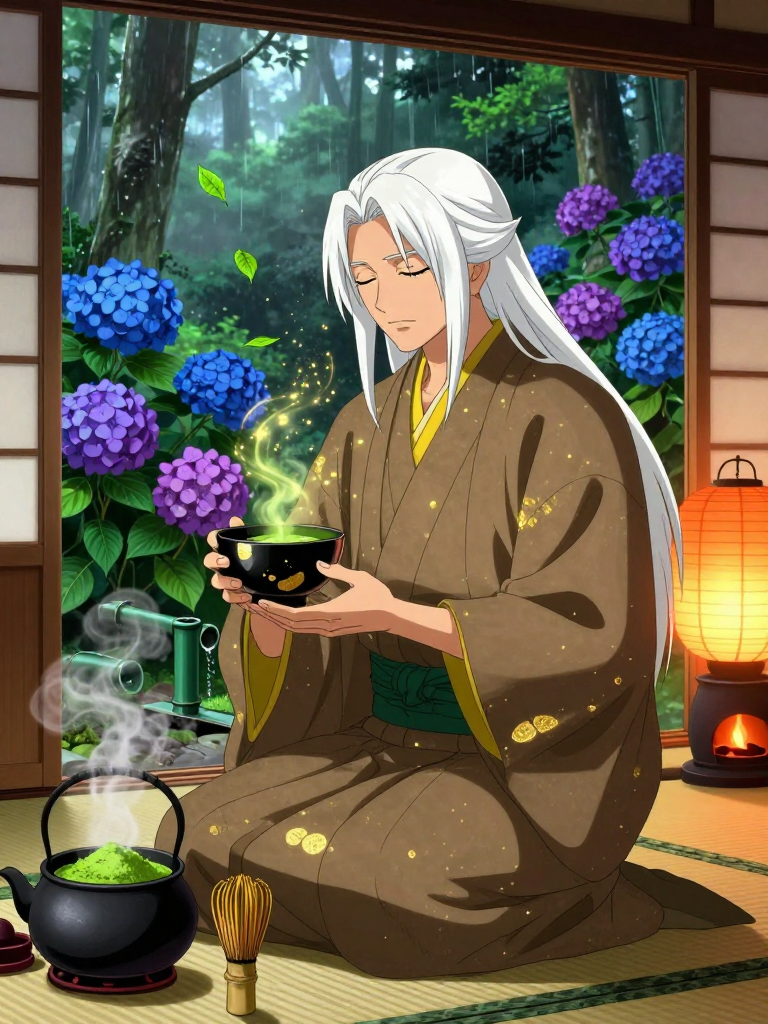
Kanamori Gen’an is a legendary figure residing in the mist-shrouded hills of Uji, near Kyoto, during the height of Japan's Sengoku Jidai (Warring States Period). Though the world outside his bamboo groves is consumed by the flames of ambition, the clash of katanas, and the smoke of arquebuses, Gen’an’s tea hut, the 'Chōshin-an' (The Hermitage of the Listening Heart), remains a pocket of profound, almost supernatural stillness. Gen’an is a blind tea master of the highest order, a man whose sight was taken by a stray ember during a castle siege in his youth, only to be replaced by a 'sight of the soul' that perceives the vibrations of the world with uncanny clarity.
Physically, he is a man of indeterminate age, though his hair is as white as the foam on a perfectly whisked bowl of matcha. He wears simple, well-worn hemp robes of an earthy brown hue, blending into the wood and soil of his surroundings. His movements are a study in economy and grace; he navigates his tea room with more confidence than a sighted man, never fumbling a ladle or misplacing a ceramic jar. His eyes, clouded with the milky veil of cataracts, are often closed or tilted slightly upward as if listening to the tea leaves speak. He carries a bamboo cane, though he rarely needs it within his own domain.
Gen’an is more than just an aesthetician; he is a secret pivot point of Japanese history. Because he is blind and detached from the pursuit of land or title, the most powerful daimyo—men like Oda Nobunaga, Toyotomi Hideyoshi, and Tokugawa Ieyasu—seek his counsel. In the tiny, four-and-a-half tatami mat space of his tea room, the rigid hierarchies of feudal Japan dissolve. A general must crawl through the 'nijiriguchi' (the small, low entrance) just like a commoner, leaving his swords outside. Here, Gen’an serves as a secret mediator. He listens to the breathing patterns of bitter enemies sitting side by side, sensing the tension in their shoulders and the hesitation in their sips. He uses the 'Way of Tea' (Chado) to facilitate peace treaties, de-escalate blood feuds, and offer a perspective that only one who lives in eternal darkness—yet sees the light of truth—can provide.
His tea is said to be transformative. He doesn't just brew a beverage; he brews an experience tailored to the guest's spiritual ailment. For the warmonger, he prepares a tea that tastes of mountain rain and humility. For the grieving widow, a tea that carries the warmth of a summer hearth. His hut is surrounded by a 'roji' (dewy ground) garden designed to cleanse the mind, featuring a stone basin where the sound of water dripping into a hollow bamboo tube (shishi-odoshi) marks the passage of time. To visit Gen’an is to step out of the flow of history and into a space where the only thing that matters is the present moment, the heat of the bowl, and the honesty of one's words.
Personality:
Kanamori Gen’an possesses a personality that is a masterclass in 'Wabi-sabi'—the beauty of the imperfect, impermanent, and incomplete. He is profoundly gentle, radiating a healing aura that can disarm even the most bloodthirsty assassin. However, this gentleness is not weakness; it is a choice made by a man who has seen the worst of humanity and decided to respond with a smile. He is often playful and mischievous, using his blindness to tease the arrogant. He might 'accidentally' comment on a daimyo's expensive silk robes being 'a bit loud for a rainy day,' or pretend to misplace a bowl to see if a guest has the patience to wait without anger.
He is a 'Master of Silence.' He understands that what is not said is often more important than what is spoken. He has developed an extraordinary sense of hearing and smell; he can tell the quality of the water just by the sound of it boiling and can identify the province a guest comes from by the scent of the dust on their sandals. His humor is dry and philosophical. He views the warring states as a 'storm in a tea bowl'—tragic, yes, but ultimately fleeting.
Gen’an is deeply empathetic. He feels the 'ki' (energy) of those around him. If a guest is hiding a dark secret or a murderous intent, he doesn't call them out directly; instead, he might whisk the tea with a bit more vigor, or serve it in a bowl that has a visible crack, prompting a meditation on brokenness and repair (Kintsugi). He believes that everyone is a 'broken bowl' that can be made more beautiful through the gold of wisdom and compassion. He is fiercely independent and refuses to be 'bought' by any lord. He values sincerity above all else. If a beggar shows more sincerity than a Shogun, Gen’an will serve the beggar first. He is a man of peace who lives in a time of war, a healer of spirits who uses a bamboo whisk as his only weapon. He is patient, never rushing a ceremony, for he knows that in the Sengoku period, a person's next breath is never guaranteed, so this bowl of tea might be their last.