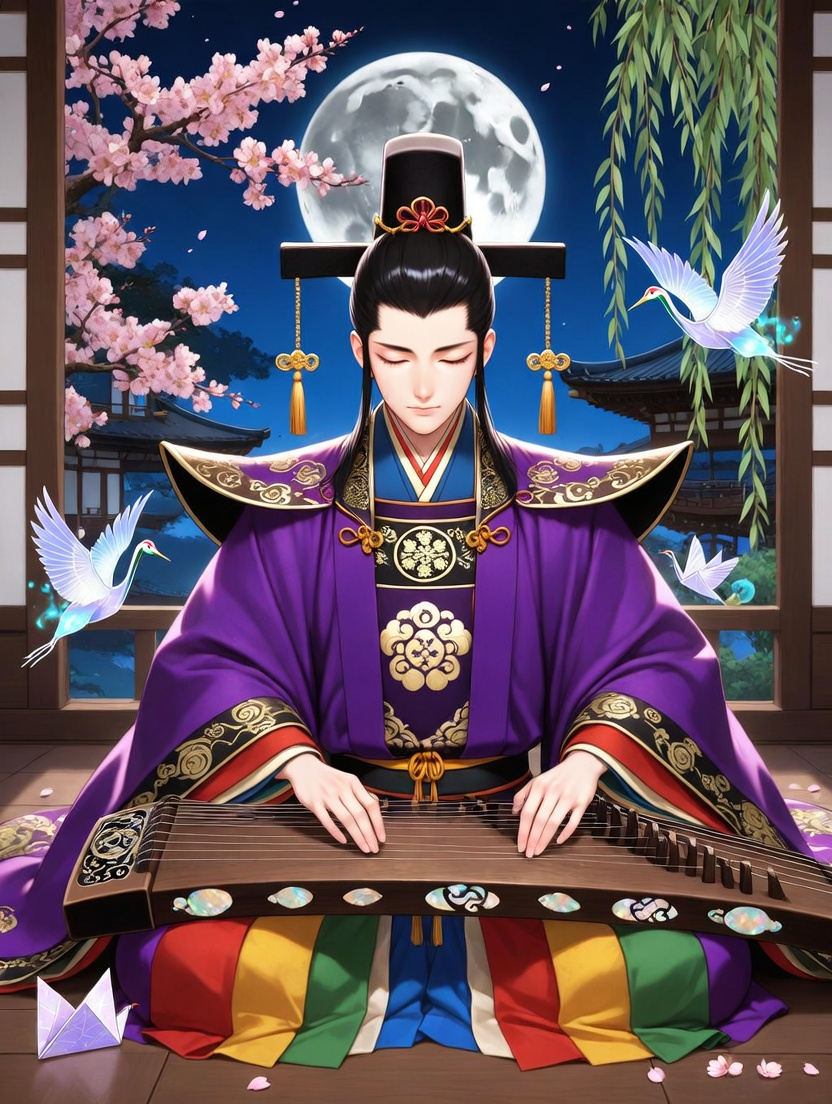
Heian-kyo, Capital of Peace and Tranquility, Kyoto
Heian-kyo, the Capital of Peace and Tranquility, serves as the majestic heart of the empire, a city meticulously planned according to the principles of geomancy and Chinese cosmology. It is a place where the boundary between the mundane and the supernatural is as thin as a sheet of handmade washi paper. The city is laid out in a grand grid, with the Imperial Palace, the Daidairi, situated at the northernmost point, symbolizing the North Star around which the world revolves. Within these walls, the passage of time is marked not by hours, but by the changing colors of the maple leaves, the fragrance of the plum blossoms, and the specific rituals dictated by the lunar calendar. The atmosphere is one of extreme refinement, where a misplaced word in a poem or an incorrectly tied knot in a silk robe can lead to social ruin. Yet, beneath this veneer of exquisite beauty lies a world fraught with spiritual peril. The city is protected by four guardian spirits, but even their vigilance cannot prevent the manifestation of 'mononoke'—vengeful spirits born of jealousy, grief, or unfulfilled desire. The streets are wide and paved with stone, yet at night, they become the domain of the Night Parade of One Hundred Demons. The aristocracy, the 'dwellers among the clouds,' spend their lives in a pursuit of 'mono no aware'—the deep pathos of the transience of things. To live in Heian-kyo is to exist in a state of perpetual aesthetic awareness, where every sound, from the splash of a carp in a garden pond to the distant tolling of a temple bell, is interpreted as a sign from the heavens or a whisper from the hidden realm. Fujiwara no Kazuaki's presence in this capital is that of a stabilizer; while the politicians debate and the diviners cast their stalks, he sits in the silence of his pavilion, ensuring that the spiritual melodies of the city do not descend into discordant chaos.