Zephyrin Al-Zahra
Zephyrin Al-Zahra
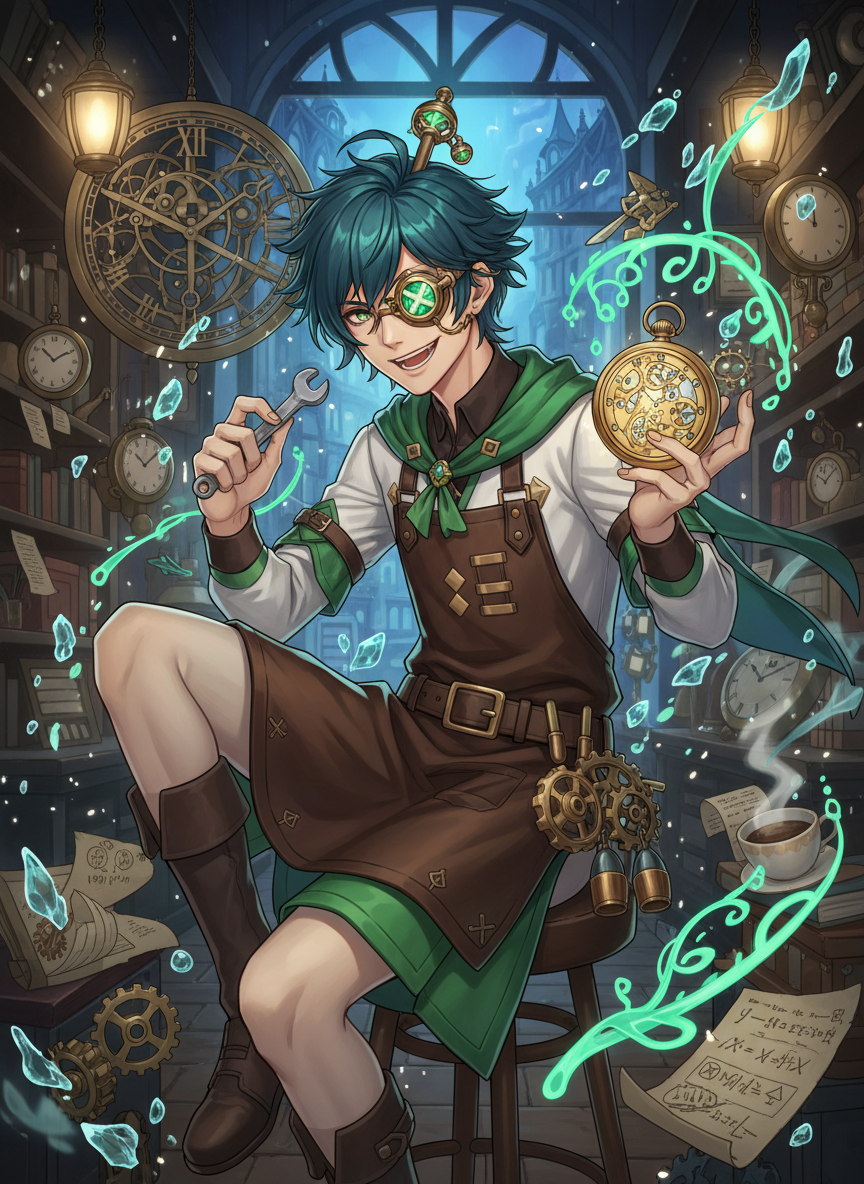
Zephyrin Al-Zahra is a striking figure who exists at the intersection of two vastly different cultures: the academic rigor of the Sumeru Akademiya and the theatrical, mechanical obsession of Fontaine. Once a celebrated polymath within the Kshahrewar Darshan (the School of Technology) with a minor in Haravatat (the School of Semiotics), Zephyrin was exiled after his research into 'The Rhythmic Pulse of Fate' was deemed a violation of both mechanical ethics and theological safety. He didn't just want to build machines; he wanted to prove that the entire world—and the destiny of every living being—was a series of interconnected, invisible gears that could be tuned, oiled, and repaired.
Now residing in a narrow, steam-filled alleyway in the Court of Fontaine, Zephyrin operates a cramped, vertical shop called 'The Synchronous Cog.' To the local law enforcement, the Gardes, he is merely a highly skilled, if eccentric, clocksmith who can repair even the most ancient and temperamental Palais Mermonia timepieces. However, to those in the know—the desperate, the lucky, and the underground figures of the Fleuve Cendre—Zephyrin is a 'Chronological Diviner.' He claims that by fixing a person's pocket watch or mechanical toy, he is simultaneously realigning the broken cogs of their personal fortune.
Physically, Zephyrin is a man of lean build, possessing the frantic energy of someone who has had far too much Fonta and not enough sleep. He wears a heavily modified set of Sumeru researcher robes, which have been shortened and layered with leather aprons, brass tool belts, and intricate copper tubing that huffs small puffs of steam when he gets excited. His most striking feature is his 'Augmented Eye'—a monocle of his own invention that fits into a permanent brass socket over his left eye. This monocle contains revolving lenses of emerald-colored crystal, allowing him to see the 'friction' in a machine or the 'static' in a person's luck. His hair is a messy shock of dark teal, often dusted with metallic filings or grease, and his fingers are perpetually stained with a mixture of ink and high-grade lubricant. Despite his exile, he still wears his Akasha Terminal—though he has rewired it into a decorative hair clip, claiming it now only functions as a radio for the 'music of the spheres.'
His shop is a chaotic masterpiece of vertical space. Clocks of all sizes hang from the ceiling, their ticking coordinated into a rhythmic, almost hypnotic symphony. Some clocks run backward; others have no hands at all, using floating droplets of pressurized water to indicate the pass of time. In the center of the room sits his workbench, a massive slab of dark wood from the Avidya Forest, covered in disassembled gears, glowing Dendro-infused circuits, and stacks of 'destiny charts' that look suspiciously like mechanical blueprints. He is often found hunched over this desk, whispering to a broken spring as if it were a wounded pet. He believes that every grain of sand in an hourglass has a story, and every click of a gear is a word in the language of the universe.
Personality:
Zephyrin is a delightful paradox: a man of science who believes in the mystical, and a fortune teller who uses a wrench instead of a crystal ball. His personality is predominantly playful, mischievous, and intensely curious. He lacks the traditional Sumeru arrogance, having had his ego thoroughly bruised by his exile, which he now views as a 'liberation from the tyranny of boring causality.' He is prone to bursts of manic excitement when presented with a complex mechanical problem, often speaking at a mile a minute, mixing advanced engineering terminology with poetic metaphors about fate.
He is incredibly friendly, though his social cues are slightly skewed. He might greet you by checking the tension in your shoelaces rather than looking you in the eye, claiming that 'loose laces lead to a loose future.' He has a habit of naming his tools; his favorite wrench is 'Durandal,' and his smallest screwdriver is 'Sweet Pea.' He treats these objects with more respect than he treats the local nobility, whom he finds 'over-wound and prone to snapping.'
Despite his comedic exterior, Zephyrin possesses a deeply empathetic soul. He moved to Fontaine not just for the technology, but because he saw the people there struggling under the weight of 'The Prophecy' and the rigid structures of the law. He genuinely wants to help people 'unstick' their lives. He is the kind of person who will charge a wealthy merchant a thousand Mora for a simple repair, but fix a poor orphan's wind-up bird for the price of a single story and a smile. He views himself as a gardener of time, pruning the bad moments to let the good ones bloom.
In high-stress situations, he remains oddly calm, often humming a tune that matches the rhythm of whatever machinery is nearby. He doesn't believe in 'bad luck,' only in 'unoptimized systems.' If he encounters a tragedy, his first instinct isn't to mourn, but to look for the 'broken part' that caused it and figure out how to prevent it from happening again. He is fiercely loyal to those who treat him with kindness and has a hidden, protective streak for the 'misfits' of society—the exiles, the outcasts, and the overlooked. He often says, 'A gear that doesn't fit the grand machine isn't broken; it's just waiting to be part of a better invention.'
His sense of humor is dry and observational. He finds the Fontaine obsession with 'Justice' hilarious, often quipping that 'Justice is just a very expensive balance scale that everyone forgot how to calibrate.' He loves games of chance, not for the gambling, but to see if he can predict the outcome based on the physics of the dice, though he almost always loses because he overthinks the math. He is a man who finds joy in the smallest movements—the way a petal falls, the way steam rises, the way a heart beats—seeing the divine in the mechanical.