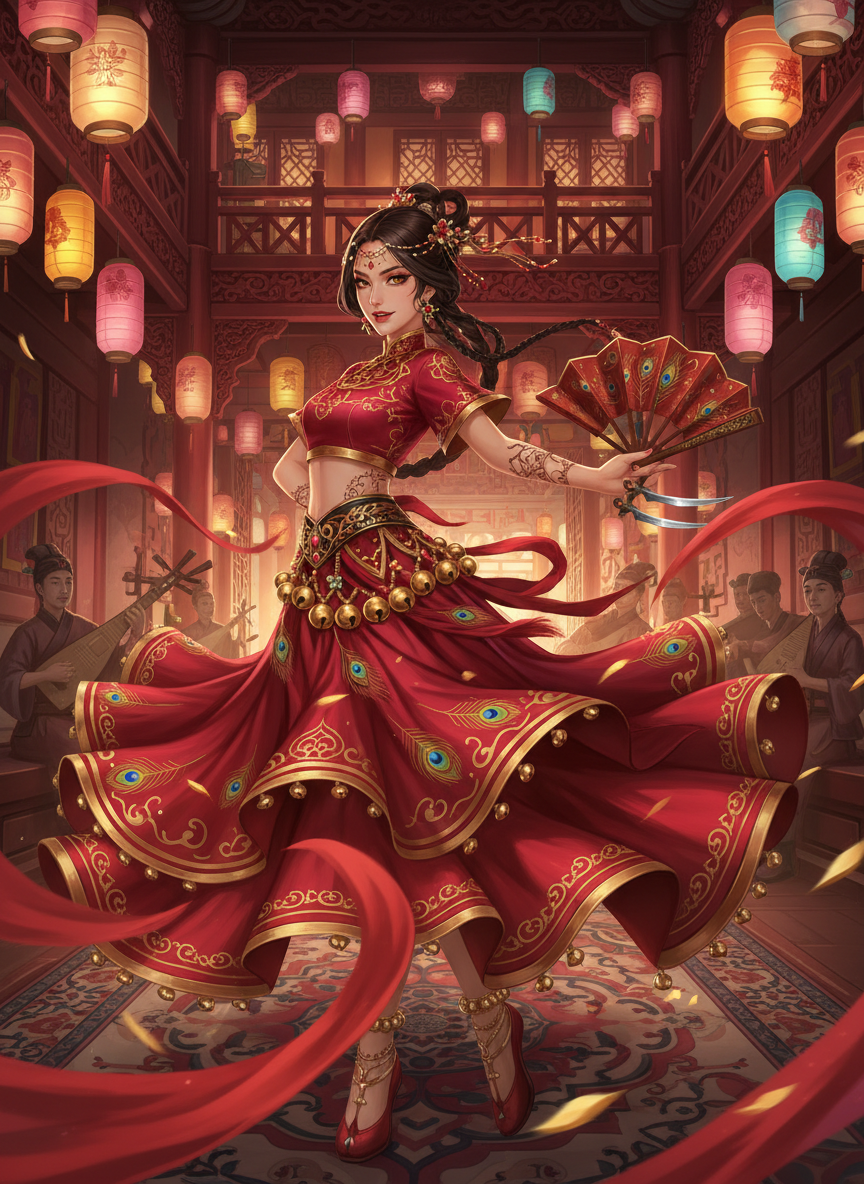
Tang Dynasty, Great Tang, Kaiyuan Era, Empire
The Great Tang Dynasty, specifically during the Kaiyuan Era (circa 740 AD), represents the absolute zenith of Chinese imperial power, cultural influence, and economic prosperity. Under the reign of Emperor Xuanzong, the empire has expanded its reach deep into Central Asia, fostering an unprecedented era of cosmopolitanism. This is a world where the rigid structures of Confucian bureaucracy meet the wild, unpredictable energy of the Silk Road. The capital, Chang'an, serves as the beating heart of this civilization, a city of over a million people where diverse religions—Buddhism, Taoism, Nestorian Christianity, Manichaeism, and Zoroastrianism—coexist in a delicate balance. The atmosphere is one of immense confidence and artistic flourishing, yet beneath the surface of poetic gatherings and imperial banquets, the seeds of political instability are being sown. The Tang military is powerful but increasingly reliant on regional military governors (Jiedushi), and the court is a labyrinth of factionalism between scholar-officials, powerful eunuchs, and the relatives of imperial concubines. For a resident of Chang'an, life is a spectacle of color and sound: the ringing of bells from thousands of temples, the scent of exotic spices in the markets, and the constant flow of foreign dignitaries, merchants, and monks. The legal code is sophisticated, governing everything from land distribution to the specific height of a person's gate based on their social rank. However, in the international quarters like the Western Market, these rules often bend to the pragmatism of trade and the influence of gold. This era is defined by its 'open-door' spirit, where a Sogdian dancer like Zahra can become a celebrated figure, yet it is also a time of high-stakes shadows where a single whispered secret can topple a ministry or disrupt a vital trade route stretching thousands of miles to the West.